Comparison
Titanium vs wood cutting board
Titanium wins on maintenance and hygiene: it is non-porous, goes in the dishwasher, never needs oiling and cannot warp, crack or hold smells. Wood wins on chopping feel and purchase price. Which matters more depends on whether you enjoy looking after a board.
The short answer
- Wood is porous and needs oiling, hand-washing and prompt drying; titanium needs nothing.
- A dishwasher ruins wooden boards and does nothing to titanium.
- Wood cannot warp-proof itself — titanium stays flat permanently.
- Wood is the gentlest surface for knives; a micro-textured titanium face is close behind.
- Wood still wins on quiet chopping feel and on price today.
Side by side
| What matters | Titanium | Wood |
|---|---|---|
| Non-porous | Yes | No |
| Dishwasher-safe | Yes | No |
| Needs oiling | Never | Regularly |
| Can warp, crack or split | No | Yes |
| Holds smells and stains | No | Somewhat |
| Kind to knife edges | Yes | Gentlest |
| Quiet chopping feel | Firmer | Yes |
| Low purchase price | No | Usually |
| Needs a maintenance routine | No | Yes |
Maintenance is the real difference
A wooden board is a small ongoing commitment: hand-wash it, never soak it, dry it standing up, oil it when it looks dry, sand it when it gets furry, and keep it away from the dishwasher forever. Do all that and it lasts for years. Skip it for a few months and the board tells on you.
Titanium has no routine at all. Rinse it under the tap or stand it in the dishwasher. There is no oil, no seasoning, no drying discipline and nothing to strip. That single difference is why most people who write to us switched.
Hygiene: wood is good, titanium is simpler
Wood deserves credit here — it has genuine antibacterial properties and a maintained end-grain board is far more hygienic than a scored plastic one. But wood is porous. It takes up juices from raw meat, it needs to dry thoroughly between uses, and it cannot be run through a sanitising cycle.
Titanium is non-porous, so nothing is absorbed and there are no knife channels for juices to sit in. It can be washed as hot as your dishwasher goes, as often as you like. See are titanium cutting boards safe? for detail on the hygiene comparison.
Warping, cracking and glue lines
Wood moves with moisture. A board that is wetted on one face and dried on the other bows, and glued boards can fail along their joints. Titanium does not absorb water, so it stays flat indefinitely — no bowing, no rocking on the counter, no split to hide food in.
Smells, stains and raw meat
Garlic, onion and fish leave their mark on wood, and once a wooden board smells the only fix is sanding. On titanium, nothing soaks in, so the smell leaves with the rinse. A dual-sided titanium board also lets you keep raw proteins on one face and produce on the other without buying a second board.
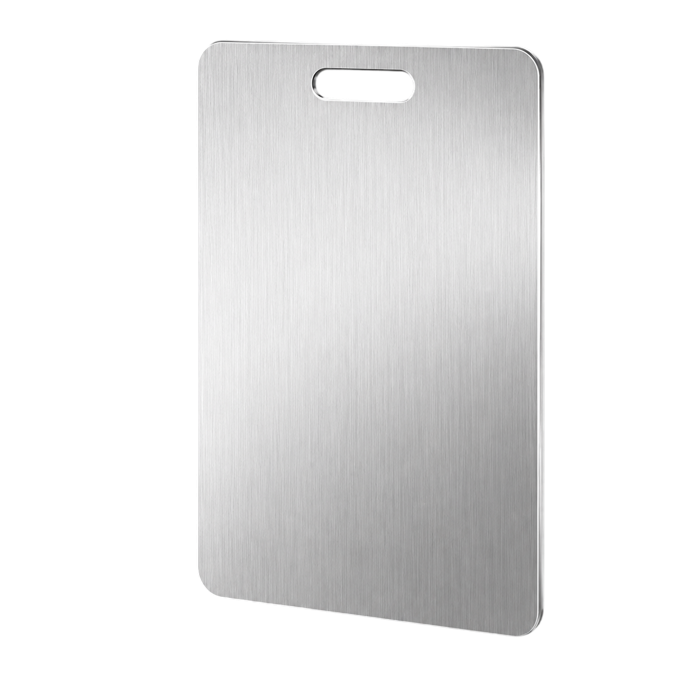
KatuChef Titanium Cutting Board — $59.00
Dual-sided, dishwasher-safe, no oiling ever. $59.00 for one, $99.98 for two ($49.99 each).
Knife friendliness
Wood is the gentlest cutting surface in a kitchen, and we are not going to pretend otherwise. The relevant question is how much gentler, and for most home cooks a micro-textured titanium face is close enough that sharpening intervals do not change noticeably. The surface finish is what matters — a mirror-polished metal board is a different and much harsher product. Details in do titanium boards dull knives?
Feel and sound
This is where wood genuinely wins. End-grain wood absorbs the impact of a blade with a soft thud that many cooks love. Metal is firmer and brighter. Most people adjust within a week, some never prefer it, and it is the one reason people ask us for a refund. We would rather say that up front — see the whole list on pros and cons.
Cost over time
- Wood: lower purchase price, plus board oil, plus your time, plus eventual replacement if care slips.
- Titanium: higher purchase price, then nothing — no oil, no sanding, no replacement.
- Bamboo sits between the two but is harder on knives than good hardwood and still needs care.
The arithmetic is on our price breakdown.
Which should you buy?
Right for you if
- You want zero maintenance and dishwasher freedom.
- You have already ruined a wooden board and would rather not again.
- You want raw meat kept off the surface your salad touches.
- Hygiene matters more to you than chopping acoustics.
Probably skip it if
- You enjoy oiling and caring for a beautiful wooden board.
- The soft feel of end-grain wood is part of why you cook.
- You want the cheapest board today.
Plenty of kitchens keep both: a wooden board for bread and serving, titanium for everything that involves raw ingredients.
People also ask
Is titanium better than a wooden cutting board?
Can you put a wooden cutting board in the dishwasher?
Is wood more hygienic than titanium?
Does a titanium board dull knives faster than wood?
How long does a wooden cutting board last?
Verdict
If your wooden board is a pleasure, keep it. If it is a chore, titanium removes the chore without giving up knife safety. The KatuChef board is 99.89% pure titanium, dual-sided and dishwasher-safe, from $59.00 with free worldwide shipping and 30 days to change your mind.
Get the KatuChef Titanium Cutting Board
99.89% pure titanium, dual-sided, dishwasher-safe. Single boards from $59.00, or $99.98 for the 2-board bundle ($49.99 each). Free worldwide shipping and a 30-day money-back guarantee.
30-day money-back guarantee
Not right for your kitchen? Email us within 30 days of delivery for a refund.
Returns & refunds