
Safety
Are titanium cutting boards non-toxic?
Yes — solid titanium is about as inert as a food-contact material gets. There is no polymer, so no BPA, phthalates or plasticisers; no adhesive, so no glue lines; no coating or sealant, so nothing to wear through. The one caveat is purity: a 'titanium-coated' board is a different product.
The short answer
- No BPA, phthalates or plasticisers, because there is no plastic in the board.
- No glue lines, unlike glued wood and bamboo boards.
- No sealants or mineral oils needed, so nothing added over time.
- Titanium does not react with acidic or salty food.
- Buy solid titanium with a stated purity — coatings are the weak point.
What "non-toxic" has to mean for a cutting board
A cutting board is not a passive object. A knife removes material from it thousands of times, hot water and detergent run over it, and acidic food sits on it. So "non-toxic" has to cover three questions: does the material shed particles, does it react with food, and does anything have to be added to it to keep it usable?
| Material | Sheds particles? | Reacts with food? | Needs added treatments? |
|---|---|---|---|
| Solid titanium | No | No | No |
| Plastic | Yes, when cut | No | No |
| Wood | Fibres only | No | Yes — oils and sometimes sealants |
| Bamboo | Fibres only | No | Yes — plus adhesive in the laminate |
| Coated metal | Depends on the coating | Depends on the coating | No |
Why titanium is inert
Titanium forms a stable, tightly bonded oxide layer that shields the metal beneath. That is why it is a standard material for joint replacements and dental implants that live inside the body for decades, and for cookware people boil tomato sauce in. Lemon, vinegar, salt and wine simply do not get anywhere with it.
- No BPA, phthalates or plasticisers — there is no polymer to contain them.
- No rust, so no iron oxide flaking into food.
- No metallic taste from acidic ingredients, unlike some steel surfaces.
- Non-porous, so nothing soaks in and nothing needs sealing.
The titanium dioxide question
People searching for this often find headlines about titanium dioxide as a food additive. That is a fine powder used as a whitener, and it is a different subject from a solid metal object. A board is bulk titanium with a stable surface oxide; it is not a powder, it does not abrade into a powder, and it is not an ingredient in your food.
Where the real caveat is: coatings
If a board is described as titanium-coated, titanium-plated or having a titanium finish, then the food-contact surface is that layer, not titanium in bulk — and the layer is being worked on by a knife every day. You cannot assess a coating you have no information about, which is why we push people towards a stated purity figure and the word solid. More in pure titanium explained.
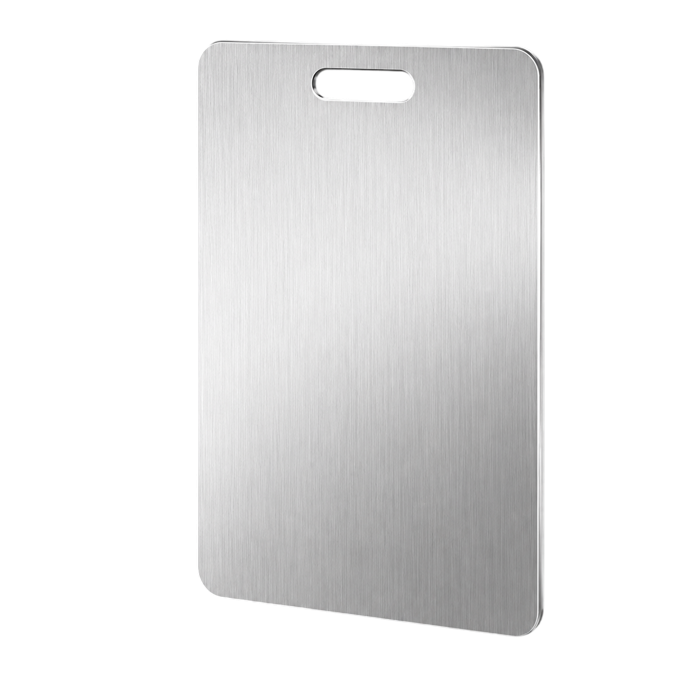
KatuChef Titanium Cutting Board — $59.00
99.89% pure titanium, no coatings, no oils: $59.00 for one, $99.98 for two ($49.99 each).
Compared with the alternatives
- Plastic: cutting removes material from the board, and some of it ends up in food — see our microplastics page.
- Bamboo: laminated strips held with adhesive, and harder on knives than good hardwood.
- Sealed or finished wood: the finish is an added material you did not choose, and it wears.
- Coated metal: unknown surface layer doing the hardest job on the board.
Full comparisons: vs plastic, vs wood, and the microplastics evidence.
What we are not claiming
We are not making health claims about your kitchen or telling you a plastic board has harmed you. What we can say precisely is what this board is made of and what it does not contain, and let you decide what that is worth. There is more on how we handle claims in what reviews to trust.
Who this matters most to
Right for you if
- You are actively trying to reduce plastic in food contact.
- You prep a lot of citrus, tomato or vinegar-based food.
- You want a board with no oils, sealants or adhesives at all.
- You cook for small children and want the simplest possible material.
Probably skip it if
- You are happy with a well-maintained hardwood board.
- Price today is your deciding factor.
People also ask
Are titanium cutting boards non-toxic?
Is titanium the most non-toxic cutting board material?
What about titanium dioxide — is that a concern?
Do coated titanium boards stay non-toxic?
Is plastic really a toxicity concern?
The answer, short
Solid titanium is non-toxic in the way that matters for a cutting board: nothing to shed, nothing to react, nothing to add. The KatuChef board is 99.89% pure titanium, dual-sided and dishwasher-safe, from $59.00 with a 30-day money-back guarantee.
Get the KatuChef Titanium Cutting Board
99.89% pure titanium, dual-sided, dishwasher-safe. Single boards from $59.00, or $99.98 for the 2-board bundle ($49.99 each). Free worldwide shipping and a 30-day money-back guarantee.
30-day money-back guarantee
Not right for your kitchen? Email us within 30 days of delivery for a refund.
Returns & refunds