Safety
Are titanium cutting boards safe?
Yes. Titanium is non-porous and one of the most inert metals used around food — it does not rust, does not react with acid, contains no BPA or plasticisers, and sheds nothing into your food. On the two things that actually make a board unsafe, absorbed juices and knife grooves, it has neither.
The short answer
- Titanium is inert: nothing leaches, even with acidic or salty food.
- Non-porous means no absorbed juices and nothing to seal or oil.
- No knife grooves form, so washing reaches the entire surface.
- No polymer, so no microplastics and no BPA or phthalates.
- The only practical cautions are grip when wet and the board's weight.
What makes a cutting board unsafe in the first place
It helps to be precise about the risk. A cutting board becomes a hazard in two ways: it absorbs juices into a porous material, or it develops deep knife channels that hold food debris below the surface where washing does not reach. Everything else — colour, brand, price — is noise.
Plastic fails on the second count, which is why food-safety guidance says to replace scored plastic boards. Wood is porous and needs drying discipline. Titanium has neither weakness.
| Material | Porous? | Develops knife grooves? |
|---|---|---|
| Titanium | No | No — marks are surface patina |
| Plastic | No when new | Yes, and quickly in daily use |
| Wood | Yes | Yes, but self-closing to a degree |
| Glass | No | No, but it destroys knife edges |
Why titanium is chemically inert
Titanium forms a stable oxide layer that protects the metal beneath. That is why it is used for joint replacements and dental implants which sit in the human body for decades, and for camping cookware people boil acidic food in.
- Does not rust, unlike steel, which is stain-resistant rather than stain-proof.
- Does not react with lemon, tomato, vinegar or wine, and leaves no metallic taste.
- Contains no BPA, phthalates or plasticisers, because there is no plastic involved.
- Withstands any dishwasher temperature without degrading.
Purity matters here, because a coated board's food-contact surface is the coating rather than the metal — see pure titanium explained.
Bacteria: the practical picture
No surface is sterile before it is washed. What differs is how easily it can be washed clean. On titanium, the whole surface is reachable: there are no pores and no channels, so hot water and detergent, or a dishwasher cycle, get everywhere the food was.
Microplastics
Cutting on plastic abrades the board, and researchers have measured plastic particles released during ordinary chopping. Titanium has no equivalent mechanism — there is no polymer to remove. The evidence is summarised on cutting boards and microplastics, and the material comparison is in titanium vs plastic.
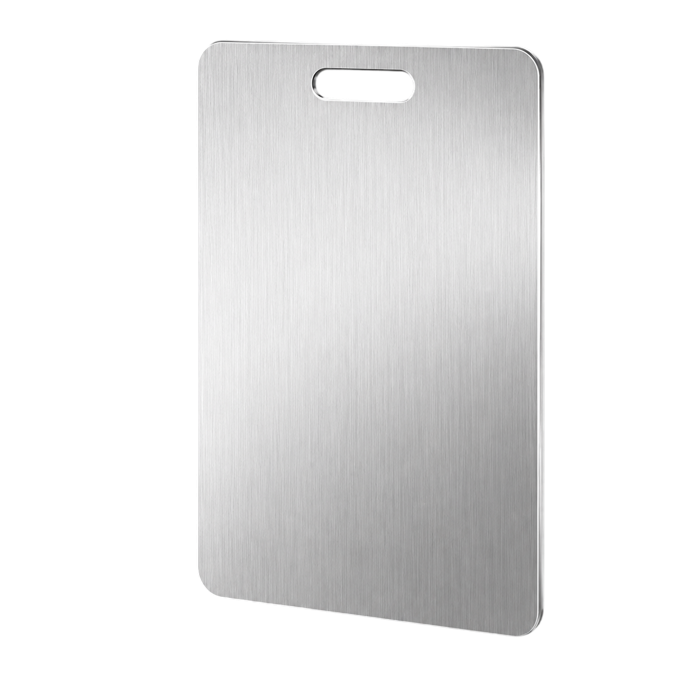
KatuChef Titanium Cutting Board — $59.00
Non-porous, inert, dishwasher-safe: $59.00 for one board, $99.98 for two ($49.99 each).
Do the marks on the surface matter?
No. A brushed titanium face develops a patina of fine marks with use, the way a good pan does. Those are not grooves cut into a porous material — the metal is not opened up, so there is nothing trapped and nothing weakened. Full explanation in do titanium boards scratch?
Safe handling, honestly
- Wet metal is slippery — choose a board with cut-out handles or a grip edge.
- A rigid board has real weight; carry it with both hands when it is wet.
- Keep raw proteins on one face and produce on the other, and let the dishwasher do the rest.
- Do not use it as a chopping block for bone-in cuts with a cleaver.
Is it the right board for you?
Right for you if
- You want microplastics and absorbed juices out of your prep.
- You want a board you can sanitise in a hot dishwasher forever.
- You handle raw meat regularly and want a surface that washes truly clean.
- You prep acidic food and want no reaction or metallic taste.
Probably skip it if
- You prefer the soft feel of end-grain wood and maintain it properly.
- You want the cheapest board available today.
People also ask
Are titanium cutting boards safe to use?
Can bacteria grow on a titanium cutting board?
Does titanium leach into food?
Is a titanium cutting board safe for raw meat?
Are there any safety downsides?
The answer, short
Titanium is safe because it is inert and non-porous, and safe over time because it never becomes the grooved board that guidance tells you to throw out. The KatuChef board is 99.89% pure titanium, dual-sided and dishwasher-safe, from $59.00 with a 30-day money-back guarantee.
Get the KatuChef Titanium Cutting Board
99.89% pure titanium, dual-sided, dishwasher-safe. Single boards from $59.00, or $99.98 for the 2-board bundle ($49.99 each). Free worldwide shipping and a 30-day money-back guarantee.
30-day money-back guarantee
Not right for your kitchen? Email us within 30 days of delivery for a refund.
Returns & refunds