Best boards
Best titanium cutting boards
The best titanium cutting board is a solid, high-purity, rigid board with a micro-textured cutting face, two usable sides and a cut-out handle. Every meaningful difference between titanium boards on sale today comes down to those four things — plus whether the metal is solid or merely a coating.
The short answer
- Solid high-purity titanium beats titanium-coated boards in every respect that matters.
- Surface finish decides knife friendliness; mirror-flat metal is the one to avoid.
- Dual-sided boards remove the need for a second board for raw meat.
- Rigidity is what separates a board that feels premium from one that drums.
- KatuChef is our own board, built to that spec, from $59.00.
How we judge a titanium cutting board
Five criteria decide whether a titanium board is worth its price. They are all checkable before you buy, and they are the same criteria in our buyer's guide.
- Solid vs coated: is the whole board titanium, or is titanium a finish over another metal?
- Purity: high-purity titanium is inert, rust-free and taste-free.
- Rigidity: it should not flex, rock or drum under a heavy stroke.
- Cutting face: micro-textured, not mirror-polished.
- Usability: two working faces, a cut-out handle, and a size your sink accepts.
1. Best overall: KatuChef Titanium Cutting Board
Our own board, and the reason this site exists. It is 99.89% pure titanium all the way through rather than a coating, dual-sided so raw proteins never share a face with salad, and finished with a laser-cut micro-texture that gives under a blade instead of skating it flat. It goes in the dishwasher, needs no oil, and does not stain, warp or hold onion smell.
- Solid 99.89% pure titanium, not plated or coated.
- Two finished cutting faces for raw and ready-to-eat food.
- Micro-textured surface designed around knife edges.
- Cut-out handle for lifting, carrying and upright storage.
- Free worldwide shipping and a 30-day money-back guarantee.
The honest trade-offs: it costs more than a plastic board, and metal is a firmer, louder chopping surface than end-grain wood. We list every downside on the pros and cons page.
2. Best for keeping raw meat separate: any true dual-sided board
Cross-contamination is the one hygiene problem a single board cannot solve on its own. A genuinely dual-sided board — both faces finished for cutting, not one decorative back — lets you dedicate a face to raw chicken and fish. Two boards is better still if more than one person preps at once, which is why the 2-board bundle at $99.98 ($49.99 each) is the most popular option.
3. Best for heavy batch prep: go large, but check the sink
If you break down produce in bulk, a bigger board saves real time. The limit is not your counter — it is whether the board fits flat under the tap and upright in the dishwasher. Our sizing guide works through that in order.
4. Best for small kitchens, camping and grilling
Titanium's strength-to-weight ratio is why it ends up in camping gear. A compact titanium board cannot crack, absorb moisture or hold odour, so it copes with a cooler, a truck bed and a grill-side table in a way wood never will.
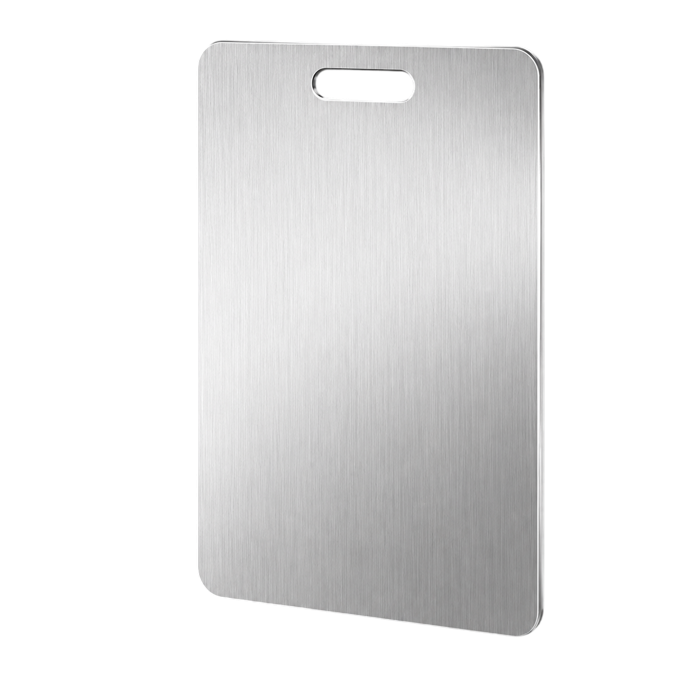
KatuChef Titanium Cutting Board — $59.00
KatuChef: solid 99.89% titanium, dual-sided, dishwasher-safe. $59.00 for one, $99.98 for two.
5. Best avoided: titanium-coated boards
The cheapest "titanium" boards are steel or aluminium with a titanium-coloured finish. They photograph identically and behave completely differently: coatings wear at the edges and around cut-outs first, and a partly worn coating is a worse cutting surface than either material on its own. Check for a stated purity, and read what pure titanium actually means before buying on price.
| Type | Solid titanium | Knife-safe face | Verdict |
|---|---|---|---|
| Solid high-purity, micro-textured | Yes | Yes | What to buy |
| Solid titanium, mirror-polished | Yes | No | Hygienic, but hard on edges |
| Titanium-coated steel or aluminium | No | No | Avoid — the coating wears |
| Stainless steel board | No | Usually not | Non-porous, but reactive and heavy |
For the wider category, including aluminium and steel, see metal cutting boards explained. If you are comparing specific brands, we cover that in brands compared, plus dedicated pages for shoppers weighing the Taima and Tivano boards.
What titanium boards are genuinely better at
- Hygiene: non-porous, so there are no cut grooves for juices and bacteria to sit in.
- No microplastics: nothing sheds into your food, ever.
- Zero maintenance: no oiling, sanding, bleaching or deodorising.
- Dishwasher tolerance: hot cycles do not warp, crack or strip anything.
- Longevity: no replacement cycle to budget for.
The head-to-head detail is on our comparison pages: vs plastic, vs wood, vs glass and vs stainless steel.
Who should buy one
Right for you if
- You want plastic out of your food prep permanently.
- You are done with oiling, sanding and hand-washing boards.
- You cook most days and want one board that lasts.
- Food safety and cross-contamination matter to you.
Probably skip it if
- You want the cheapest board on the shelf.
- You prefer the soft sound and feel of end-grain wood.
- You will not use the dishwasher anyway and enjoy board care.
People also ask
What is the best titanium cutting board overall?
Are cheap titanium cutting boards worth buying?
Which titanium board is best for knives?
What size titanium board is best?
Is titanium better than a wooden board?
Our recommendation
Buy solid, high-purity titanium with a micro-textured face and two usable sides, and buy it from a seller who will refund you. That is the KatuChef board: from $59.00, or $99.98 for two, with free worldwide shipping and a 30-day money-back guarantee.
Get the KatuChef Titanium Cutting Board
99.89% pure titanium, dual-sided, dishwasher-safe. Single boards from $59.00, or $99.98 for the 2-board bundle ($49.99 each). Free worldwide shipping and a 30-day money-back guarantee.
30-day money-back guarantee
Not right for your kitchen? Email us within 30 days of delivery for a refund.
Returns & refunds