Knives
Do titanium cutting boards dull knives?
Not noticeably — as long as the cutting face is micro-textured rather than polished. The property that protects a knife edge is give at the point of contact, not softness in general. Glass has none, which is where this fear comes from. A textured titanium face is engineered to have some.
The short answer
- Edge damage comes from unyielding flat surfaces, not from hardness by itself.
- A micro-textured face gives slightly at thousands of contact points.
- Glass and polished metal are the genuinely bad surfaces.
- Wood is still the gentlest; the gap to a textured titanium face is small.
- Technique and storage blunt knives faster than most board choices.
The physics, briefly
A knife edge is a wedge of steel a few microns wide at the tip. When it meets a surface, one of two things happens. Either the surface deforms slightly and absorbs the impact — the edge survives — or the surface does not move at all and the edge deforms instead. That deformation is what "dull" means: the very tip rolls over or micro-chips.
So the question is never "how hard is this material?" but "how much does this surface give at the exact point the blade lands?" Tempered glass gives nothing anywhere, which is why it is the worst common cutting surface. Wood gives obviously and generously.
What a micro-textured face does
Instead of one continuous rigid plane, a micro-textured titanium face presents thousands of small raised points. The blade contacts a fraction of the surface, each contact point yields a little, and the load is spread rather than concentrated. That is the whole design intent, and it is why a properly finished titanium board is not comparable to a mirror-polished metal sheet.
| Surface | Give at contact | Effect on edges |
|---|---|---|
| End-grain wood | High | Gentlest available |
| Edge-grain wood | Moderate | Very good |
| New plastic | Moderate | Good while smooth |
| Scored plastic | Uneven | Inconsistent, worse than new |
| Micro-textured titanium | Slight but real | No meaningful change for most home cooks |
| Polished metal | None | Poor |
| Tempered glass | None | Worst — rolls edges immediately |
The glass comparison in detail is on titanium vs glass, and the wood comparison on titanium vs wood.
Being honest about the wood comparison
We are not going to claim titanium is gentler than end-grain wood. It is not. Wood is the softest common cutting surface and it always wins that specific test. What we will say is that for most home cooks the difference between wood and a micro-textured titanium face does not change how often they reach for a honing rod — while the difference between plastic and titanium changes how hygienic their prep is.
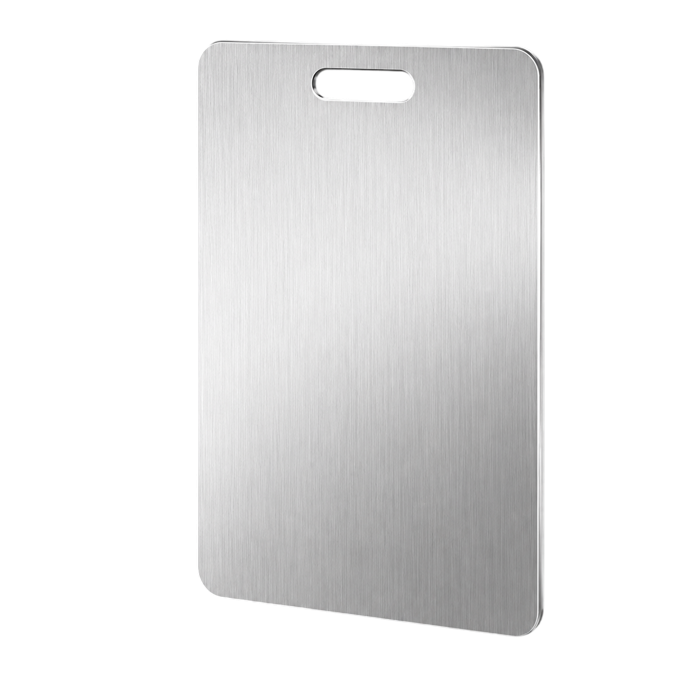
KatuChef Titanium Cutting Board — $59.00
Micro-textured on both faces: $59.00 for one, $99.98 for two ($49.99 each). 30-day guarantee, so test it on your own knives.
The habits that really blunt your knives
- Scraping the edge sideways across the board to gather food — use the spine or a bench scraper.
- Cutting on a plate or straight in a pan, which is glass and steel respectively.
- The dishwasher: detergent and knocking against other items damage edges fast.
- Loose drawer storage without a guard, block or magnetic strip.
- Never honing. A rod between sharpenings does more for you than any board.
Fix those five and your edges will last longer than they do now, whatever you cut on.
What to do if you are worried
- Buy from somewhere with a real returns window and test it with your own knives for a week.
- Use a straight downward chop rather than a dragging cut.
- Keep a honing rod next to the board and use it briefly, often.
- If you own very hard thin Japanese blades, keep a wooden board for those and use titanium for the rest.
Is a titanium board right for your knives?
Right for you if
- You use ordinary German or stainless kitchen knives.
- You hone regularly and cut with a clean downward motion.
- You want hygiene without going back to a glass or plastic board.
Probably skip it if
- Your entire kit is very hard, very thin Japanese steel and it never leaves wood.
- You gather food by scraping the blade sideways and would rather not change that.
People also ask
Do titanium cutting boards dull knives?
Why does glass destroy knives but titanium does not?
Will I need to sharpen more often?
Are expensive Japanese knives safe on titanium?
What actually dulls knives most in a home kitchen?
The answer, short
Titanium with a micro-textured face does not blunt knives the way glass does, and for most home cooks nothing about their sharpening routine changes. The KatuChef board is micro-textured on both faces, from $59.00 with a 30-day money-back guarantee — try it on your knives.
Get the KatuChef Titanium Cutting Board
99.89% pure titanium, dual-sided, dishwasher-safe. Single boards from $59.00, or $99.98 for the 2-board bundle ($49.99 each). Free worldwide shipping and a 30-day money-back guarantee.
30-day money-back guarantee
Not right for your kitchen? Email us within 30 days of delivery for a refund.
Returns & refunds