Knives
Are titanium cutting boards bad for knives?
Some metal boards are, and it comes down to the finish. A polished, mirror-flat metal surface behaves like glass and rolls edges. A micro-textured titanium face gives slightly at each contact point, which is why it does not. The word 'titanium' on a box tells you nothing about this — the photo of the cutting surface does.
The short answer
- Polished metal faces are hard on knives; micro-textured faces are not.
- Hardness is not the deciding property — give at the contact point is.
- Glass is the genuinely damaging surface people are remembering.
- Lateral scraping and twisting damage edges more than a good board does.
- Keeping a wooden board for very hard Japanese knives is a reasonable choice.
Where this worry comes from
Anyone who has cut on a tempered-glass board knows the feeling: a bright click, and a knife that feels blunt within a week. Glass is harder than knife steel and completely rigid, so the edge absorbs everything. People then generalise, reasonably, to "hard surfaces destroy knives" — and metal boards inherit the reputation.
The generalisation is where it goes wrong. The variable that matters is whether the surface yields at the exact point of contact. See titanium vs glass for the direct comparison.
Polished versus micro-textured, side by side
| Polished metal face | Micro-textured titanium face | |
|---|---|---|
| Contact area | One continuous rigid plane | Thousands of small raised points |
| Give at contact | Effectively none | Slight but real |
| Effect on the edge | Rolls and micro-chips | No meaningful change in normal use |
| Feel | Hard and skittish | Firm and controlled |
| Typical listing | Cheap steel sheet boards | Purpose-made titanium prep boards |
The mechanics in one paragraph
A knife edge is only a few microns wide at the tip, so it concentrates enormous pressure into a tiny area. On a giving surface, the surface deforms and the edge survives. On a rigid plane, the edge deforms instead. A textured face works because the blade only touches part of the surface and each of those points can move a little. Fuller explanation on do titanium boards dull knives?
What damages knives more than your board
- Scraping the edge sideways across the board to sweep food into a pan.
- Twisting the blade mid-cut through something dense like a squash.
- Cutting bone, frozen food or hard shells with a thin slicing knife.
- The dishwasher — detergent plus knocking against other items.
- Loose drawer storage without a guard.
- Never honing between sharpenings.
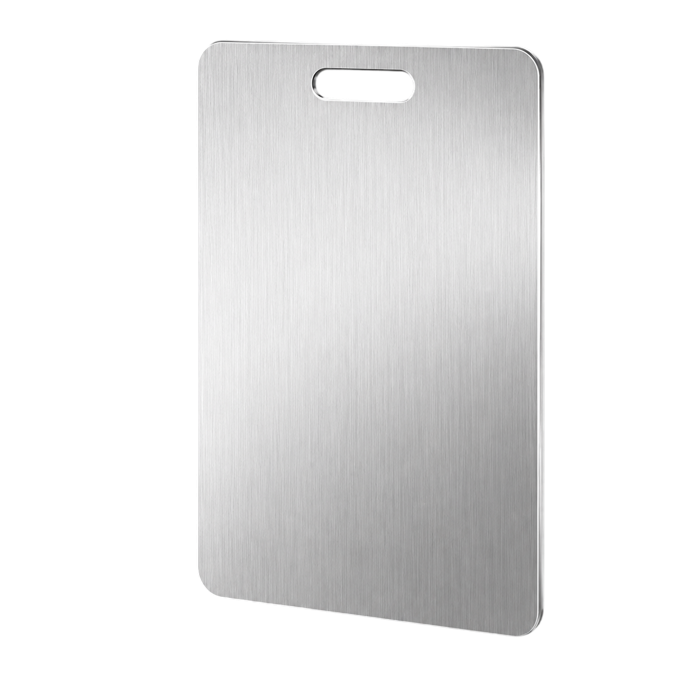
KatuChef Titanium Cutting Board — $59.00
Micro-textured on both faces, and 30 days to test it on your own knives: $59.00 for one, $99.98 for two ($49.99 each).
How to cut on a metal board
- 1Cut straight down Let the weight of the knife do the work instead of dragging the edge across the surface.
- 2Never scrape with the edge Sweep food off with the spine of the blade or a bench scraper. Sideways scraping is the single worst habit for an edge.
- 3Keep the blade square Twisting mid-cut is what chips fine edges, on any board material.
- 4Hone often, sharpen rarely A few passes on a rod between sharpenings keeps an edge in better shape than occasional heavy sharpening.
- 5Store knives properly Hand-wash and dry them, then use a magnetic strip, a block or blade guards rather than a loose drawer.
Which knives to be careful with
Very hard, very thin Japanese blades — high-Rockwell steels ground to a fine edge — are less forgiving of any error on any surface. They are not ruined by a textured board, but if you own a few and treat them carefully, keeping a wooden board for them costs you nothing. Use titanium for general prep, raw proteins and anything you want to sanitise properly.
Is a titanium board right for your kit?
Right for you if
- You use standard stainless or German kitchen knives.
- You want the hygiene of metal without glass's penalty.
- You are willing to cut downward rather than scrape sideways.
- You want to test it with a returns window rather than take our word for it.
Probably skip it if
- Your whole kit is thin, very hard Japanese steel that never leaves end-grain wood.
- You want the single gentlest possible surface, regardless of hygiene or maintenance.
People also ask
Are titanium cutting boards bad for knives?
Is titanium harder than knife steel?
Will my knives chip on a titanium board?
How should I cut on a metal board to protect my edges?
Should I keep a wooden board too?
The answer, short
Bad metal boards are bad for knives; a micro-textured titanium face is not. The KatuChef board is textured on both sides and comes with a 30-day money-back guarantee, from $59.00 — the only test that counts is your own knives on your own board.
Get the KatuChef Titanium Cutting Board
99.89% pure titanium, dual-sided, dishwasher-safe. Single boards from $59.00, or $99.98 for the 2-board bundle ($49.99 each). Free worldwide shipping and a 30-day money-back guarantee.
30-day money-back guarantee
Not right for your kitchen? Email us within 30 days of delivery for a refund.
Returns & refunds