Guide
Metal cutting boards, explained
Metal boards solve the two problems people have with plastic and wood: they are non-porous, and they never develop knife grooves. But 'metal' covers everything from inert titanium to plated sheet aluminium, and the surface finish matters more than the material name. Here is how to tell them apart.
The short answer
- Metal is non-porous and cannot shed microplastics — the main reason to switch.
- Titanium is the best metal here: inert, rust-proof and light for its stiffness.
- Stainless steel is the budget option and can pit or rust over time.
- Avoid aluminium and any coated or plated board.
- Surface finish, not hardness, decides how kind a metal board is to knives.
Why people move to metal at all
Two reasons dominate. The first is microplastics: cutting on plastic removes material from the board, and some of it goes into the food. The second is grooves — a scored plastic board holds juices below the surface where washing does not reach, which is why food-safety advice is to replace those boards.
Metal has neither problem. Nothing abrades into your food, nothing soaks in, and knife channels never form. Full detail is on cutting boards and microplastics.
The four metals you will see
| Metal | Verdict | Why |
|---|---|---|
| Titanium (high purity) | Best choice | Inert with acid, cannot rust, light for its stiffness, available with a knife-friendly micro-textured face. |
| Stainless steel | Workable | Non-porous and cheap, but stain-resistant rather than stain-proof and heavy; usually sold with a flat face. |
| Aluminium | Avoid | Soft, reacts with acidic food and marks badly. Anodising wears through where you cut most. |
| Coated or plated boards | Avoid | The coating is the food-contact surface and it wears exactly where the knife lands. |
The two head-to-heads worth reading are titanium vs stainless steel and what "pure titanium" actually means.
Surface finish decides everything about knives
The fear that metal destroys blades comes from glass and from polished steel, and it is justified for both. An edge is protected by a surface that yields a fraction of a millimetre at contact. A mirror-flat metal face yields nowhere, so the edge takes the whole impact.
A micro-textured face changes that. Thousands of tiny raised points give slightly as the blade lands, spreading the load instead of concentrating it on a single unyielding plane. This is why two boards made of the same metal can behave completely differently. See do titanium boards dull knives?
What to check before you buy any metal board
- Material stated throughout, with a purity figure — not 'titanium-coated' or 'titanium finish'.
- A micro-textured cutting face rather than a polished sheet.
- Enough thickness and rigidity that the board does not flex or drum.
- Grip: cut-out handles or a raised edge, because wet metal is slippery.
- Two usable faces, so raw proteins never share a surface with produce.
- A real returns window, so you can test the chopping feel in your own kitchen.
The long version, including sizing, is our titanium cutting board buyer's guide.
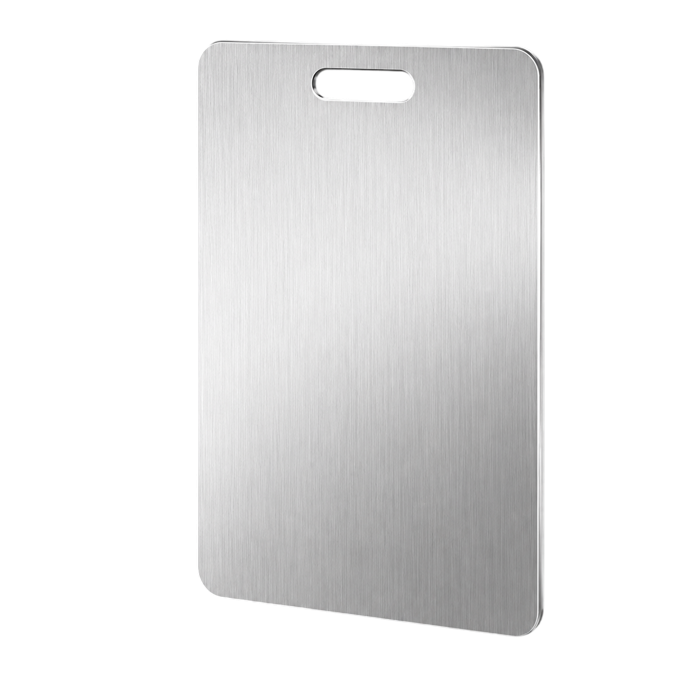
KatuChef Titanium Cutting Board — $59.00
Micro-textured, dual-sided, 99.89% pure titanium: $59.00 for one, $99.98 for two ($49.99 each). Free worldwide shipping.
Noise and feel: the honest downside
Metal is firmer than end-grain wood, and there is a period of adjustment. It is not the sharp crack of glass — a thick, rigid board absorbs and mutes the strike — but if the soft thud of wood is part of why you enjoy cooking, you will notice the change. Thin sheet-metal boards are the ones that genuinely rattle; rigidity is what fixes it.
Cleaning
This is where metal is unbeatable. Rinse and it is clean, because nothing soaked in. Put it in the dishwasher as hot as you like, as often as you like — no warping, no stripping, no oiling, no drying discipline. Our care guide covers the few things worth knowing.
Cost
A metal board costs more up front than plastic and has no replacement cycle, which is the whole financial argument. Steel is cheaper than titanium; titanium buys inertness, corrosion immunity and lower weight. Numbers are on the price breakdown.
Is a metal board right for you?
Right for you if
- You want microplastics out of your food prep.
- You are done replacing scored, stained boards.
- You want a board you can sanitise in the dishwasher forever.
- You want raw and ready-to-eat food on separate faces.
Probably skip it if
- The soft feel and sound of wood is non-negotiable for you.
- You want the cheapest board on the shelf today.
- You need many colour-coded boards for a commercial kitchen system.
People also ask
Are metal cutting boards a good idea?
Which metal is best for a cutting board?
Do metal cutting boards dull knives?
Are metal cutting boards more hygienic than plastic?
Are metal cutting boards noisy?
The short version
Metal is the right category if hygiene is your driver — just buy the right metal with the right face. The KatuChef board is 99.89% pure titanium, micro-textured, dual-sided and dishwasher-safe, from $59.00 with a 30-day money-back guarantee.
Get the KatuChef Titanium Cutting Board
99.89% pure titanium, dual-sided, dishwasher-safe. Single boards from $59.00, or $99.98 for the 2-board bundle ($49.99 each). Free worldwide shipping and a 30-day money-back guarantee.
30-day money-back guarantee
Not right for your kitchen? Email us within 30 days of delivery for a refund.
Returns & refunds