Buyer's guide
Titanium cutting board buyer's guide
Buying a titanium cutting board comes down to six things: purity of the metal, rigidity, the finish of the cutting face, size against your sink, the handle, and what happens if it ever fails. Get those right and the board outlives every plastic and wooden board in your kitchen.
The short answer
- High purity matters because it is what keeps the board inert, rust-free and taste-free.
- Surface finish decides knife friendliness — mirror-flat metal is hard on edges, micro-textured metal is not.
- Buy the biggest board that still fits your sink and your storage slot.
- A dual-sided board replaces a second board for raw meat.
- Fair pricing for a genuine titanium board starts around $59.00; bundles bring it to $35.90 each.
Why people switch to titanium in the first place
Almost nobody shops for a titanium cutting board out of curiosity. They arrive after a specific annoyance: a plastic board that has gone grey and grooved, a wooden board that split after one trip through the dishwasher, or a news story about plastic boards shedding microplastics into food. Titanium answers all three at once because it is non-porous, unaffected by hot water and detergent, and sheds nothing.
That framing matters when you compare products. You are not buying a novelty surface. You are buying an end to a maintenance and replacement cycle. Judge candidates on whether they actually end it.
1. Purity: the number that changes everything else
Titanium is used in surgical implants and cookware because it is exceptionally inert. That property depends on the metal being genuinely titanium rather than a titanium-coloured alloy or a plated steel core. High-purity titanium does not rust, does not react with lemon, tomato, vinegar or wine, and leaves no metallic taste behind.
The KatuChef board is 99.89% pure titanium throughout, not a coating over another metal. There is more on what that means, and how coated fakes give themselves away, in our guide to pure titanium boards.
2. Rigidity: press on it before you trust it
A metal board that flexes is unpleasant to use. It drums against the counter, it rocks under a heavy cleaver stroke, and the noise makes the whole board feel cheap. Rigidity comes from the thickness of the sheet and how the perimeter is formed, so two boards of the same stated thickness can feel completely different.
- It should sit dead still when you lean weight onto one corner.
- It should not ring or drum loudly when you chop in the middle.
- Edges should be rolled or finished, not raw sheet that can catch a fingertip.
- The board should stay flat forever — no metal board should ever bow with age.
3. Surface finish: the part that decides your knife edges
This is the single most misunderstood spec, and the reason people assume metal boards ruin knives. Edge damage is not caused by hardness on its own; it is caused by an unyielding, flat surface that gives a blade nowhere to land. Glass is the extreme example, which is why glass boards genuinely do wreck knives.
A laser-cut, micro-textured titanium face behaves differently. The blade meets a surface with thousands of tiny contact points that yield slightly, so the edge is not rolled or chipped. If you are still nervous, read our full breakdown of whether titanium boards dull knives.
| Surface | Knife-friendly | Why |
|---|---|---|
| Micro-textured titanium | Yes | Contact points yield slightly, so edges are not rolled. |
| Mirror-polished metal | No | Perfectly flat and unyielding — hard on fine edges. |
| Glass or stone | No | Far harder than steel; the classic edge killer. |
| Plastic (HDPE) | Yes, at first | Kind to edges, but scores deeply and sheds particles. |
4. Size: measured against your sink, not your counter
Most people size a board by counter space and then regret it at the sink. If a board cannot sit flat under the tap or stand upright in the dishwasher, cleaning becomes a chore and you will reach for a smaller board instead. Work backwards: sink first, storage slot second, counter third. Our sizing guide walks through it.
5. Handle and edges
A cut-out handle sounds cosmetic and is not. It is how you lift a wet board without dropping it, carry prepped food to the pan, and hang or slot the board upright so both faces dry. On a metal board, a handle also gives you a place to grip that is not a cutting surface.
6. Dual-sided or not
A board with two usable faces solves cross-contamination without a second purchase: raw proteins on one face, produce and ready-to-eat food on the other. That is only true if both faces are finished for cutting — some metal boards have one working face and one decorative back.
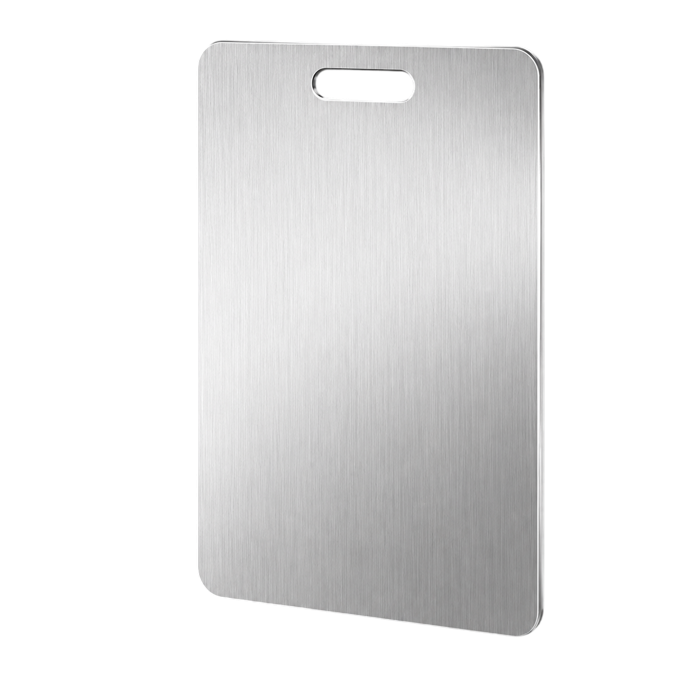
KatuChef Titanium Cutting Board — $59.00
KatuChef is dual-sided, 99.89% pure titanium and dishwasher-safe. $59.00 for one, $99.98 for two.
What a titanium cutting board should cost
Titanium is expensive to machine, so a genuine board is never a budget item. What matters is cost over the years you own it rather than the number on the tag. A plastic board replaced every 18 months and a wooden board plus a bottle of board oil both keep charging you; a titanium board does not.
| Bundle | Total | Per board | Best for |
|---|---|---|---|
| 1x KatuChef Board | $59.00 | $59.00 | Trying it in one kitchen |
| 2x KatuChef Boards | $99.98 | $49.99 | Raw and ready-to-eat kept separate |
| 3x KatuChef Boards | $137.85 | $45.95 | Busy kitchens and gifting one |
| 4x KatuChef Boards | $143.60 | $35.90 | Full set, lowest cost per board |
The full arithmetic, including how titanium compares to years of replacements, is in our price breakdown.
Warranty, returns and who you are buying from
A board sold with no return path is a board the seller does not expect to stand behind. Buying direct also matters for a product this easy to imitate — marketplace listings for "titanium" boards frequently turn out to be coated. See where to buy safely and our warranty terms.
- A stated return window, in writing, that starts at delivery.
- A working support address that a person answers.
- Clear shipping terms rather than a checkout surprise.
- A named brand and store, not a rotating marketplace seller.
Mistakes that cost buyers money
- Buying the thinnest board available to save money, then hating the noise and flex.
- Assuming all metal is hard on knives and buying glass instead — which genuinely is.
- Choosing a board too large for the sink, so it never gets cleaned properly.
- Paying titanium prices for a coated board from an unnamed marketplace seller.
- Buying one board and still using a plastic one for raw chicken.
Who a titanium board suits
Right for you if
- You want plastic out of your food prep for good.
- You cook most days and want zero maintenance.
- You are tired of replacing scored, stained plastic boards.
- You want raw meat and produce genuinely separated.
- You like kit that lasts and looks the same in five years.
Probably skip it if
- You love your wooden board and enjoy oiling it.
- You want the cheapest possible board today.
- You prefer a soft, silent chopping sound above everything else.
- You need a board large enough to break down a whole animal.
How we test, and why we are not neutral
We make and sell the KatuChef board, so treat this as an informed seller's guide rather than a review site. What we can do is be specific: everything above is a property you can check on any board, from any brand, before you spend money. Where titanium has genuine downsides — cutting noise, price, and the fact that it will never be as quiet as end-grain wood — we say so on our pros and cons page.
People also ask
How thick should a titanium cutting board be?
Is a titanium cutting board worth the money?
What size titanium cutting board should I buy?
Do I need one board or two?
How can I tell if a titanium board is genuine?
Will a titanium board damage my knives?
The short version
Buy high purity, buy rigid, buy a micro-textured face, buy the biggest size your sink can handle, and buy from someone who will take it back. The KatuChef Titanium Cutting Board is built to that spec: 99.89% pure titanium, dual-sided, dishwasher-safe, with a cut-out handle, free worldwide shipping and a 30-day money-back guarantee. Bundles start at $59.00.
Get the KatuChef Titanium Cutting Board
99.89% pure titanium, dual-sided, dishwasher-safe. Single boards from $59.00, or $99.98 for the 2-board bundle ($49.99 each). Free worldwide shipping and a 30-day money-back guarantee.
30-day money-back guarantee
Not right for your kitchen? Email us within 30 days of delivery for a refund.
Returns & refunds