
Reviews
Titanium cutting board review: our honest verdict
Reviews in this category are unusually noisy: the same photographs appear under a dozen brand names, and star counts are easy to buy. So here is a plain review of the board we make, scored criterion by criterion, with the drawbacks stated as clearly as the strengths — plus how to read anyone else's titanium cutting board reviews before you spend money.
The short answer
- Our verdict: 4.6/5 — outstanding on hygiene, cleaning and durability; firmer and louder than wood.
- The three honest complaints: firmer chopping feel, higher price than plastic, visible fine surface marks.
- What holds up in daily use: no smells, no stains, no oiling, dishwasher-safe, no knife grooves.
- Knife wear comes from the cutting face, not from the word titanium — polished metal and glass are the real culprits.
- Identical photos under many brand names usually means one coated board being resold.
- We publish no star ratings or review counts here, because we will not invent numbers we cannot verify.
Our scored verdict
Short version: as a hygiene and low-maintenance upgrade over plastic, a solid titanium board is hard to beat. As a replacement for the feel of a thick end-grain wood block, it is a compromise, and anyone who tells you otherwise is selling.
Our verdict — scored by the team that makes it
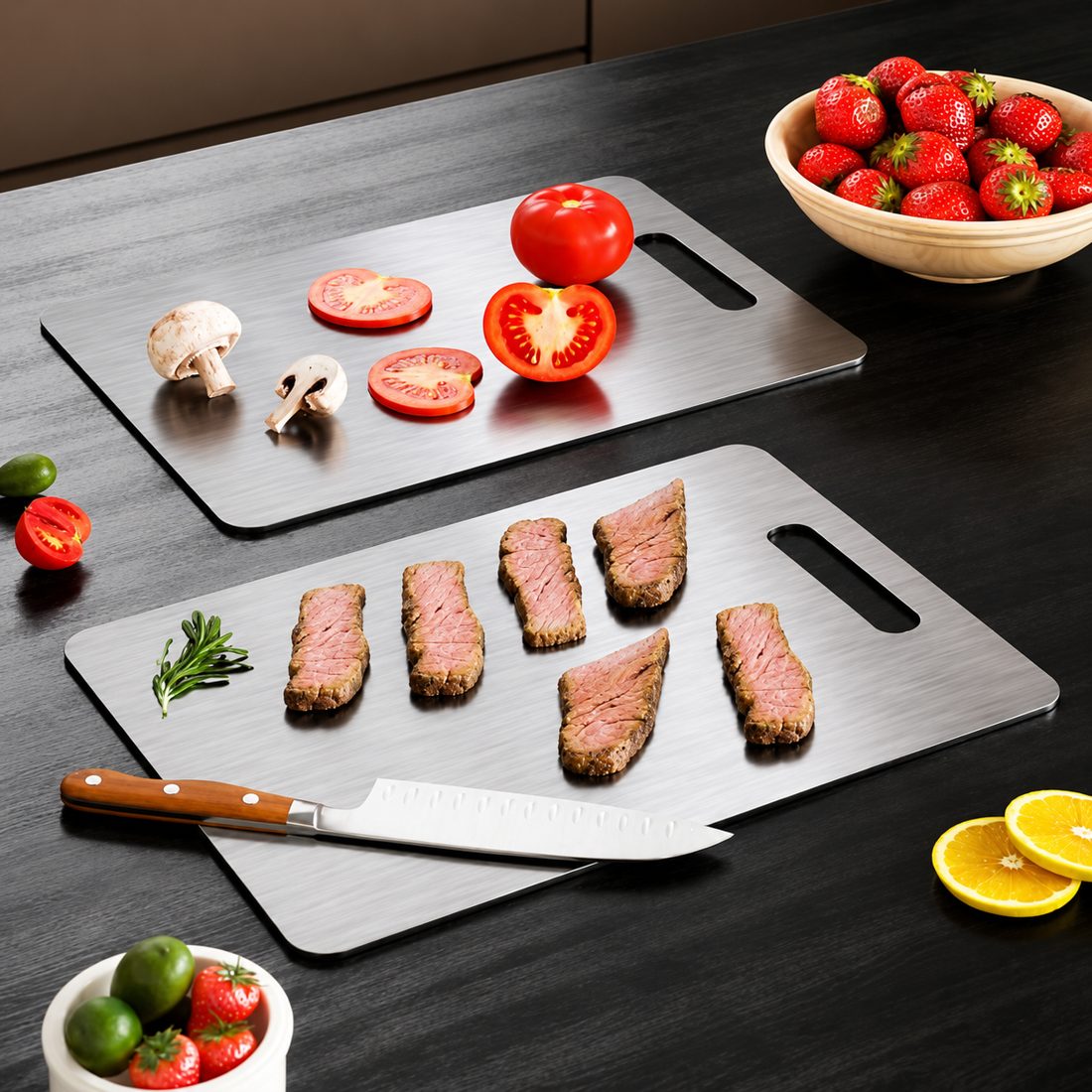
4.6 / 5- Hygiene5.0Non-porous with no knife grooves, so juices have nowhere to sit. Two usable faces let raw meat and produce stay genuinely separated.
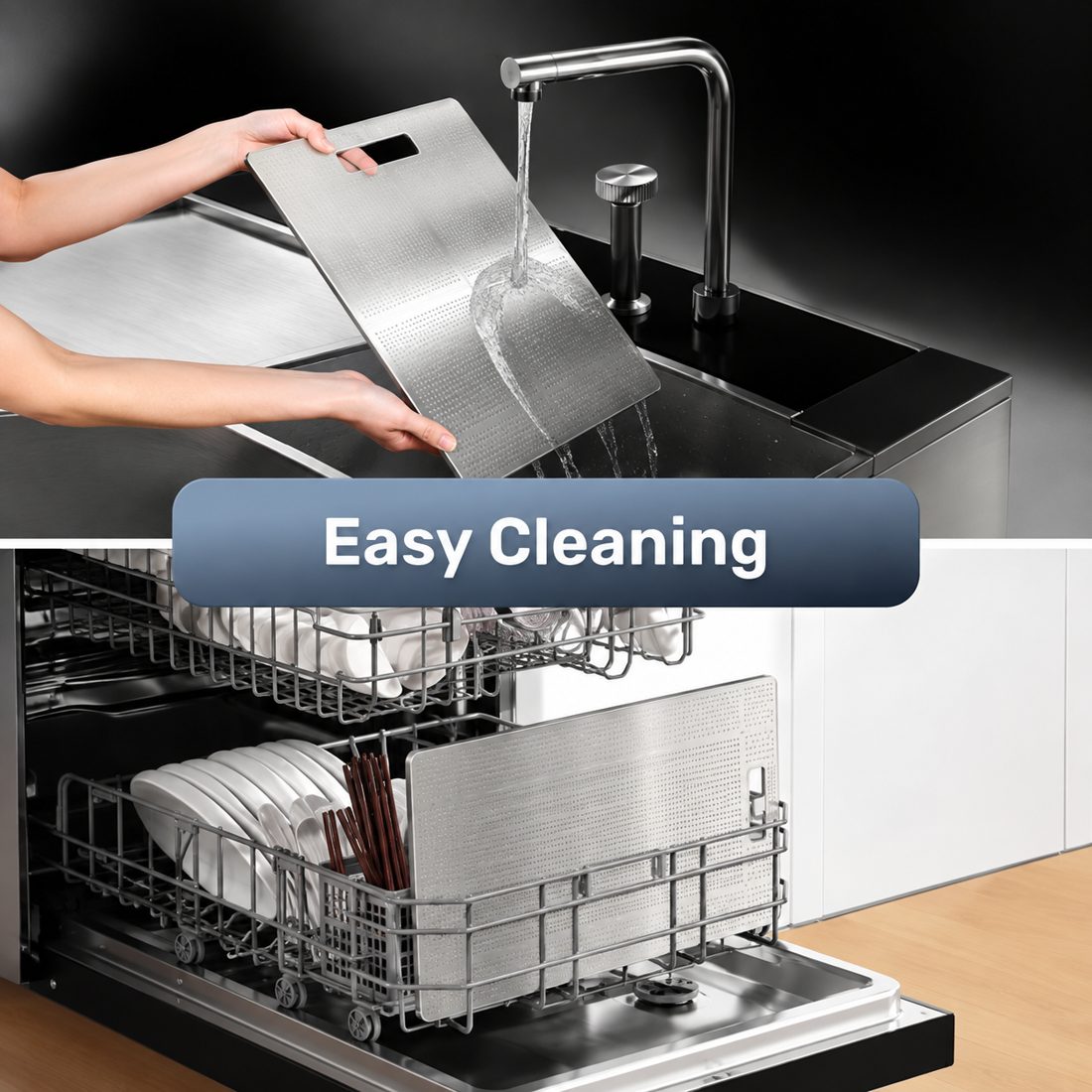
- Cleaning5.0Rinse with a drop of soap, or dishwasher. No oiling, no sanding, no bleach soak, no deodorising step, ever.
- Knife friendliness4.5The micro-textured face yields at contact points rather than rolling edges the way glass does. Still firmer than wood.
- Durability5.0Does not warp, crack, swell, stain or rust. It picks up a used patina instead of degrading.
- Cutting feel3.5Firmer and louder than wood. Most people stop noticing within a week; some genuinely never like it.
- Value4.5Costs more than plastic up front — from $59.00, or $49.99 each in a pair — and removes the replacement cycle and board oil afterwards.
These scores are our own stated opinion after testing, not customer ratings. We publish no star counts or review totals because we will not invent numbers we cannot verify.
How we tested it
These are the checks we run, and the same ones we ask customers to run inside the return window. They are deliberately boring and repeatable, so you can reproduce every one of them at home rather than take our word for it.
- 1Dense-vegetable chopping Squash, swede and carrot, to see whether the board stays still under real force and whether the feel is tolerable over a full prep session.
- 2Smell test Raw onion, garlic and fish, then a plain rinse. Nothing should remain on the surface or in the sink afterwards.
- 3Stain test Tomato, beetroot, turmeric and lemon left on the surface, then rinsed. Nothing sets in and nothing changes the taste of the next thing you cut.
- 4Dishwasher cycles Repeated full cycles, checking for warping, spotting or any surface change. It comes out the same board it went in as.
- 5Knife check before and after Slice paper with a freshly sharpened knife, use the board for a week of normal cooking, then slice paper again with the same knife.
What we deliberately do not do is publish numbers we cannot support. You will not find a star rating, a review count or a customer quote anywhere on this site, because we have not collected verified ones yet. That decision costs us conversions and we are keeping it.
What holds up in daily use
The positives reported for solid titanium boards are remarkably consistent, because they come directly from the material rather than from any brand's design choices.
- No lingering smells. Garlic, onion and fish do not soak in, because nothing can.
- No stains. Turmeric, beetroot and tomato rinse off instead of setting in.
- No maintenance. No oiling, no sanding, no bleach soak, no deodorising step.
- Fast cleaning. A rinse and a drop of soap, or straight into the dishwasher.
- No knife grooves. There are no cut channels for juices and bacteria to sit in.
- It looks the same after months of use, rather than going grey and furry like plastic.
The three complaints that are actually true
Any honest review of a metal board includes these, and we would rather you hear them from us than find them out on day three.
| Complaint | Fair? | The reality |
|---|---|---|
| Louder, firmer chopping feel | Yes | Metal will never feel like end-grain wood. Most people stop noticing within a week; some never like it. |
| Costs more than plastic | Yes | True at the till. Untrue over years, since there is no replacement cycle or board oil. |
| Shows fine surface marks | Yes | A brushed metal face develops a used patina. It does not open pores or trap bacteria. |
| Dulls knives | No | That comes from glass and mirror-polished metal. A micro-textured face is a different surface entirely. |
| Rusts or reacts with acidic food | No | High-purity titanium does not rust and is inert with lemon, vinegar and wine. |
The scratch question comes up so often we gave it its own page: do titanium cutting boards scratch? And if knives are your concern, start with do titanium boards dull knives?
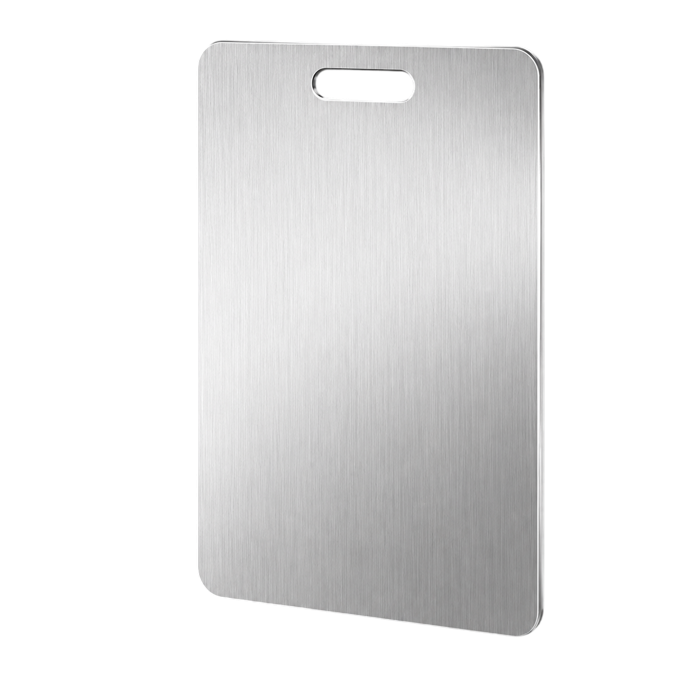
KatuChef Titanium Cutting Board — $59.00
Judge it in your kitchen: $59.00 for one, $99.98 for two ($49.99 each), free worldwide shipping and a 30-day money-back guarantee.
Other titanium board brands, and what to check
Most searches for reviews in this category are really searches for reassurance about a specific listing — Tivano, Taima, Apex, Katori or an unbranded marketplace board. We will not score other people's boards from photographs, because that is exactly the dishonesty this page exists to warn about. What we can do is tell you which claims to demand in writing.
| What to check | Why it matters | Good answer looks like |
|---|---|---|
| Solid or coated? | Coated boards dominate the cheap end. A coating can wear through, and what is underneath is not titanium. | Solid titanium throughout, stated plainly |
| Stated purity | Vague 'titanium alloy' wording hides how little titanium is involved. | A specific purity figure, such as 99.89% |
| Cutting face finish | Mirror-polished metal is genuinely hard on knife edges; micro-textured is not. | Micro-textured or brushed cutting face |
| Two usable sides | Raw meat and produce separation is half the reason to buy metal. | Both faces intended for cutting |
| Returns window | Chopping feel is personal. You need a way out if you dislike it. | A clear no-questions return period |
| Who answers support | Marketplace resellers often cannot answer a product question at all. | A named seller with a working support address |
Brand-by-brand context lives on titanium cutting board brands compared, with dedicated pages for the two most searched: Tivano alternative and Taima alternative. If you want the purity question explained properly, read pure titanium cutting boards.
How to spot a review section you cannot trust
- The same product photos appear under several different brand names.
- Reviews praise 'fast delivery' and 'good packaging' but never the cutting surface.
- Hundreds of ratings appeared within days of the listing going live.
- No review mentions weight, noise or how the board looks after a month of use.
- The listing never states a titanium purity or admits the board is coated.
Video reviews are useful for one thing
Watch what the camera shows rather than what the voiceover claims. A video that chops something dense, shows the surface close up afterwards, and cuts paper with the knife before and after is worth more than any written review. A video that only unboxes the board tells you nothing about the next twelve months.
That last listing point is the important one. Coated boards dominate the cheap end of this category — see pure titanium explained and where to buy safely.
What to test in your first week
If you buy any titanium board, ours or anyone's, these five checks tell you whether it was worth the money. Do them inside the return window.
- Chop something dense — squash or a swede. Does the board stay dead still?
- Cut raw onion, then rinse. Does the board smell of anything afterwards?
- Dice tomato and lemon. Any taste change, any mark left behind?
- Run it through a full dishwasher cycle. Anything warped, stripped or spotted?
- Slice paper with your knife before and after a week of use. Notice a difference?
How we handle feedback
Support email goes to people who work on this product, not a ticket queue. When something is a genuine design issue we change the product; when it is a preference — chopping feel is the usual one — we say so and refund. Our returns policy is deliberately plain: 30 days from delivery, no interrogation.
Who ends up happy with a titanium board
Right for you if
- You are replacing a scored, stained plastic board.
- Cleaning speed and hygiene matter more to you than chopping acoustics.
- You want zero maintenance for years.
- You want raw and ready-to-eat food genuinely separated.
Probably skip it if
- The soft thud of end-grain wood is part of why you cook.
- You want the cheapest board available today.
- You will be annoyed by fine surface marks on brushed metal.
People also ask
Is a titanium cutting board worth it?
Are titanium cutting board reviews trustworthy?
What do people complain about most with titanium boards?
Are titanium cutting boards bad for knives?
Are titanium cutting boards safe for food?
Does the KatuChef board stain or hold smells?
Are titanium cutting boards made in the USA?
Why don't you show star ratings on this page?
The bottom line
Ignore star counts in this category and shop the specification instead: solid high-purity titanium, rigid, micro-textured cutting face, two usable sides. That is what the KatuChef board is — 4.6/5 by our own honest scoring, from $59.00 with free worldwide shipping and 30 days to change your mind if the chopping feel is not for you.
Get the KatuChef Titanium Cutting Board
99.89% pure titanium, dual-sided, dishwasher-safe. Single boards from $59.00, or $99.98 for the 2-board bundle ($49.99 each). Free worldwide shipping and a 30-day money-back guarantee.
30-day money-back guarantee
Not right for your kitchen? Email us within 30 days of delivery for a refund.
Returns & refunds