Comparison
Titanium vs stainless steel cutting board
Both are non-porous metals, so both beat plastic on hygiene. Titanium pulls ahead on the details: it is more inert with acidic food, it cannot rust, and it is much lighter for the same rigidity. Knife friendliness comes down to surface finish on either metal.
The short answer
- Titanium is inert with lemon, tomato and vinegar; steel can pit and leave a metallic note.
- Titanium does not rust; 'stainless' is stain-resistant, not stain-proof.
- Titanium is significantly lighter for the same stiffness.
- Knife wear is decided by the finish — micro-textured beats mirror-flat on any metal.
- Steel is usually cheaper and more widely stocked.
Side by side
| What matters | Titanium | Stainless steel |
|---|---|---|
| Inert with acidic food | Yes | Mostly |
| Rust-proof | Yes | Resistant only |
| No metallic taste | Yes | Can occur |
| Light for its stiffness | Yes | No |
| Non-porous | Yes | Yes |
| Dishwasher-safe | Yes | Usually |
| Knife-friendly face available | Yes | Rarely |
| Lower price | No | Yes |
Reactivity with acidic ingredients
High-purity titanium is exceptionally inert. Lemon juice, tomato, vinegar and wine sit on it without reaction, without corrosion and without changing the taste of the food. That is why titanium turns up in medical implants and outdoor cookware.
Stainless steel is good but not inert. Prolonged contact with salty or acidic food can pit lower grades, and a faint metallic note is a real complaint with steel prep surfaces. If you prep a lot of citrus and tomato, this is the round that decides it.
Rust and staining
Titanium does not rust, full stop. "Stainless" means stain-resistant, and cheaper grades show it: rust spots appear around edges, welds and cut-outs after repeated dishwasher cycles, especially where salt is involved. A cutting board is exactly the object that gets salt, acid and hot detergent.
Weight in the hand
Titanium's strength-to-weight ratio is its most famous property. A titanium board rigid enough that it never flexes is lighter to lift out of the sink, hold under a tap and slide into a storage slot than a steel board with the same stiffness. That is a small thing you notice every single day.
Knives: finish beats material
Neither metal is inherently a knife killer. What matters is whether the cutting face gives at all. Most stainless boards are sold with a smooth, near-flat surface, which behaves closer to glass than to wood. A laser-cut micro-textured titanium face has thousands of small contact points that yield slightly, which is why sharpening intervals do not change noticeably for most home cooks.
Compare actual surfaces before you buy — the mechanics are in do titanium boards dull knives?, and titanium vs glass shows what a genuinely bad surface does.
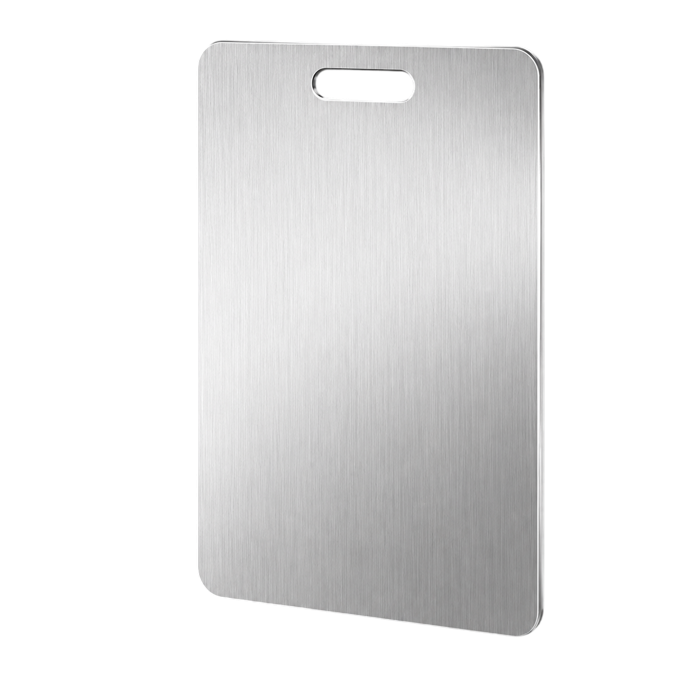
KatuChef Titanium Cutting Board — $59.00
Micro-textured, dual-sided, 99.89% pure titanium: $59.00 for one, $99.98 for two ($49.99 each).
Hygiene: a tie, and both beat plastic
Neither metal is porous, so neither develops the knife channels that make old plastic boards a problem. Both can be washed as hot as you like. If your reason for looking at metal is microplastics, either material solves it — see cutting boards and microplastics and titanium vs plastic.
Noise, grip and everyday use
- A thin steel board drums loudly; a rigid board of either metal is much quieter.
- Cut-outs and handles matter more on metal than on wood, because wet metal is slippery to grip.
- Both metals dry almost instantly, so neither needs a drying rack.
- Dual-sided use only works if both faces are genuinely finished for cutting.
Price and availability
Steel is cheaper and easier to find, because it is cheaper to source and far easier to machine. Titanium costs more for exactly those reasons, and that cost buys inertness, corrosion immunity and lower weight. The full breakdown is on our price page.
Which should you buy?
Right for you if
- You prep a lot of citrus, tomato or vinegar-based food.
- You want a metal board that will never show a rust spot.
- You want the lightest rigid metal board you can get.
- You want a cutting face designed around knife edges.
Probably skip it if
- You want the cheapest non-porous surface available today.
- You already own a steel board you are happy with and rarely cut acidic food.
People also ask
Is titanium better than stainless steel for a cutting board?
Does a stainless steel cutting board rust?
Do metal cutting boards give food a metallic taste?
Which is worse for knives, titanium or stainless steel?
Is a titanium board lighter than steel?
Verdict
Steel is the budget route into metal boards; titanium is the version without the compromises. If you want inert, rust-proof, light and knife-conscious, the KatuChef board is 99.89% pure titanium, dual-sided and dishwasher-safe, from $59.00 with free worldwide shipping and a 30-day money-back guarantee.
Get the KatuChef Titanium Cutting Board
99.89% pure titanium, dual-sided, dishwasher-safe. Single boards from $59.00, or $99.98 for the 2-board bundle ($49.99 each). Free worldwide shipping and a 30-day money-back guarantee.
30-day money-back guarantee
Not right for your kitchen? Email us within 30 days of delivery for a refund.
Returns & refunds