
Comparison
Titanium vs plastic cutting board
Titanium wins on the things that make a cutting board safe: it is non-porous, it does not develop knife grooves that hold bacteria, and it sheds nothing into your food. Plastic is cheaper today and kind to knives while it is new — but it is a consumable, and titanium is not.
The short answer
- Plastic boards score with use, and those grooves hold juices a rinse cannot reach.
- Cutting on plastic releases plastic particles; cutting on titanium releases nothing.
- Both are dishwasher-safe, but only titanium stays groove-free.
- Plastic is a repeat purchase; a titanium board has no replacement cycle.
- Plastic still wins on price today and on quiet chopping feel.
The short comparison
| What matters | Titanium | Plastic (HDPE) |
|---|---|---|
| Non-porous surface | Yes | When new |
| Stays free of knife grooves | Yes | No |
| Releases microplastics | Never | Yes |
| Dishwasher-safe | Yes | Yes |
| Resists stains and odours | Yes | No |
| Kind to knife edges | Yes | When new |
| Needs replacing | No | Every 1–2 years |
| Low purchase price | No | Yes |
| Quiet to chop on | Firmer | Yes |
Microplastics: the reason most people switch
Every cut on a plastic board removes a small amount of material. That is not a manufacturing flaw, it is what happens when a hard steel edge meets a soft polymer. Researchers have measured plastic particles released during normal chopping, and the release rises as a board gets more scored.
Titanium has no equivalent mechanism. It is a metal that does not abrade into food, and there is nothing in it to migrate — no BPA, no phthalates, no plasticisers. We go through the research and what it does and does not prove on our cutting boards and microplastics page.
Bacteria: it is about grooves, not material
New plastic is easy to clean. Scored plastic is not. Knife channels hold moisture, protein and juice below the surface where a sponge and a rinse do not reach, and that is why food-safety guidance says to replace plastic boards once they are visibly cut up.
A titanium board never gets to that state. Knives mark the finish over time — the brushed face develops a patina — but they do not open channels into the metal. There is more detail in do titanium boards scratch? and are titanium boards safe?
Knives: the honest answer
Plastic is genuinely gentle on edges while it is smooth. The comparison people expect — "surely metal is worse" — is not straightforward, because edge damage comes from unyielding flat surfaces rather than from hardness alone. Glass is the true offender, and titanium boards with a micro-textured face behave nothing like glass.
Read do titanium cutting boards dull knives? for the mechanics, and titanium vs glass for the surface that really does wreck edges.
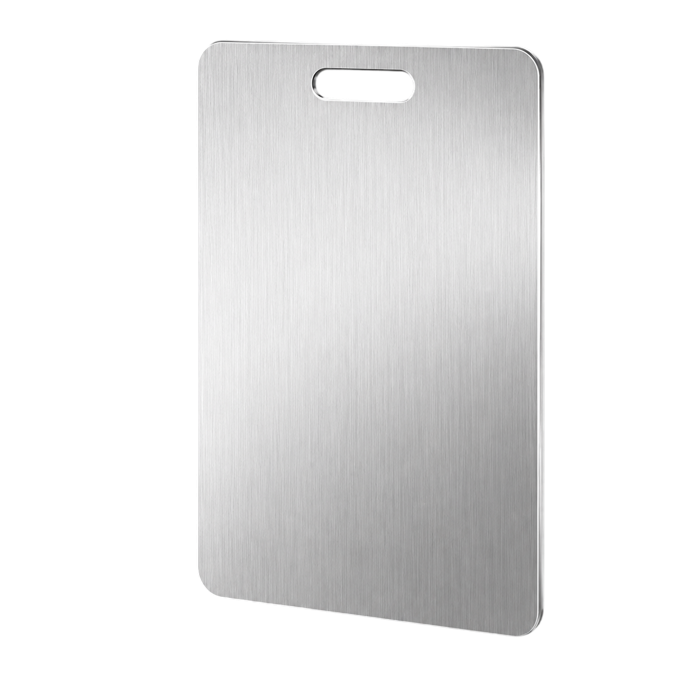
KatuChef Titanium Cutting Board — $59.00
Switch one board or all of them: $59.00 for one, $99.98 for two ($49.99 each). Free worldwide shipping.
Stains, smells and the grey plastic problem
Plastic absorbs colour and odour. Turmeric, beetroot, tomato and raw fish all leave a trace, and after a year of daily use a white board is grey, furry-looking and faintly smells of dinners past. No amount of bleaching brings it back, because the marks are below the surface.
Titanium simply rinses. Nothing soaks in, so there is nothing to bleach out, and there is no deodorising ritual with lemon and salt.
Cleaning and maintenance
- Plastic: dishwasher-safe, but warps in very hot cycles and must be replaced once scored.
- Titanium: dishwasher-safe indefinitely, no warping, no stripping, no oiling.
- Titanium dries almost instantly, so it goes straight back into its slot.
- Neither needs seasoning — that is a wood problem.
The full routine is on our care and cleaning guide.
Cost over time
A plastic board is cheap once and then keeps costing. A titanium board is expensive once and then stops. Over the years you actually keep a board, the gap narrows sharply and then reverses.
| Titanium | Plastic | |
|---|---|---|
| Purchase | From $59.00 | Low |
| Replacement cycle | None expected | Every 1–2 years in daily use |
| Consumables | None | None, but replacements are the consumable |
| Effect on knives | Micro-textured face is edge-friendly | Fine when new, uneven when scored |
Full pricing is on the price page.
When plastic is still the right call
Right for you if
- You want microplastics out of your prep.
- You are tired of replacing grey, grooved boards.
- You want a board that survives the dishwasher forever.
- You want raw and ready-to-eat food on separate faces.
Probably skip it if
- You need a dozen cheap boards for a commercial colour-coded system.
- Budget today matters more than cost over years.
- You want the quietest possible chopping surface.
People also ask
Is a titanium cutting board better than plastic?
Do plastic cutting boards release microplastics into food?
Are plastic boards more hygienic because they are dishwasher-safe?
Is plastic kinder to knives than titanium?
How often should you replace a plastic cutting board?
Verdict
Plastic is a consumable pretending to be equipment. If hygiene, microplastics and not rebuying boards matter to you, titanium is the upgrade — and the KatuChef board is dual-sided, 99.89% pure titanium and dishwasher-safe, from $59.00 with a 30-day money-back guarantee.
Get the KatuChef Titanium Cutting Board
99.89% pure titanium, dual-sided, dishwasher-safe. Single boards from $59.00, or $99.98 for the 2-board bundle ($49.99 each). Free worldwide shipping and a 30-day money-back guarantee.
30-day money-back guarantee
Not right for your kitchen? Email us within 30 days of delivery for a refund.
Returns & refunds