
Safety
Cutting boards and microplastics
Cutting on a plastic board removes material from the board, and researchers have measured plastic particles released during normal chopping. How much depends on the board, the knife and how you cut. What we can say plainly: a board with no polymer in it cannot shed plastic at all.
The short answer
- A steel edge abrades a polymer board — that is physics, not a defect.
- Studies have measured particle release during ordinary chopping; quantities vary widely.
- Worn, deeply scored boards shed more than new ones.
- Titanium, steel and untreated wood have no plastic to release.
- Change the board you use for raw, uncooked food first.
The mechanism, stated simply
A knife edge is harder than polyethylene. When it lands, it removes a sliver of the board. You can see the result on any plastic board that has been used for a year: a haze of cuts, then deep channels, then a grey, furry surface. That material went somewhere, and some of it went onto the food you were cutting.
This is why food-safety guidance says to replace plastic boards once they are deeply scored — and why the "just buy a new one" answer means buying into the cycle rather than out of it.
What the research does and does not show
Studies have measured plastic particles released from polyethylene and polypropylene boards during chopping, and reported release varying with the board material, the cutting style and the board's condition. Being straight with you about the limits matters:
- The mechanism — abrasion during cutting — is not in dispute.
- The quantities reported vary a lot between studies and setups, so a single headline number is not reliable.
- Health effects of ingesting small amounts of these particles are still being studied and are not settled.
- What is measurable today is exposure, not harm.
Which materials can shed plastic
| Material | Can shed plastic? | Notes |
|---|---|---|
| Titanium | No | Inert, non-porous, no polymer at all. |
| Stainless steel | No | No polymer; can pit or rust over time. |
| Untreated hardwood | No | Porous and needs oiling; no plastic involved. |
| Bamboo / glued wood | Adhesive present | The wood sheds no plastic, but the laminate contains glue. |
| Plastic (HDPE, PP) | Yes | Abrades with every cut; worse once scored. |
| Coated boards | Depends | The coating is the cutting surface and its composition is often undisclosed. |
Material comparisons in full: titanium vs plastic, titanium vs wood, metal boards explained.
What to do about it, in order
- 1Change the raw-food board first Salad, herbs, fruit and bread go onto the plate uncooked, so this is where the switch counts most.
- 2Retire anything visibly scored A grey, grooved plastic board sheds the most and is the hardest to wash properly.
- 3Separate raw proteins Use a second board or a second face so raw meat never shares a surface with produce.
- 4Pick a non-porous replacement Choose something you can sanitise in a hot dishwasher without warping or stripping it.
- 5Treat any remaining plastic as a consumable If you keep one for messy jobs, replace it on a schedule rather than when it looks bad.
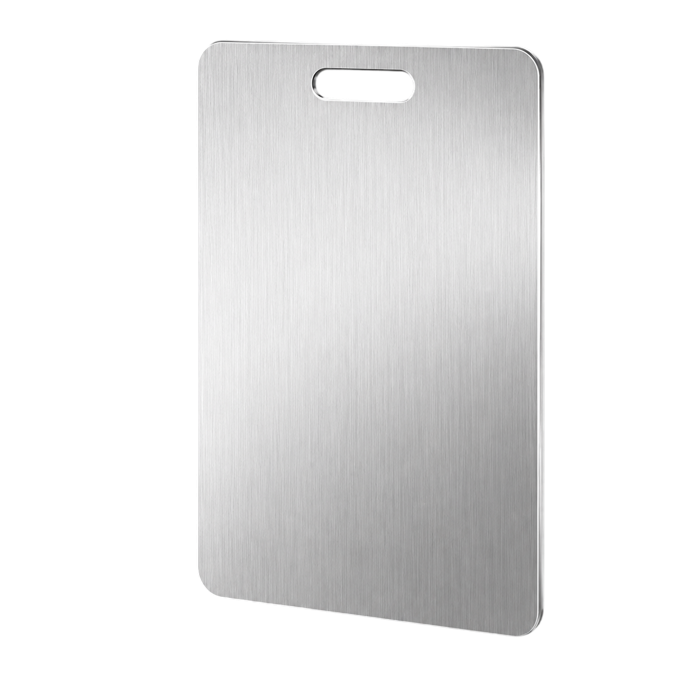
KatuChef Titanium Cutting Board — $59.00
A board with no plastic in it: $59.00 for one, $99.98 for two ($49.99 each). Free worldwide shipping.
Why titanium answers the question completely
There is no polymer to abrade, and titanium is inert enough to be used for implants and camping cookware. It is also non-porous, so juices do not soak in, and it never develops the knife channels that make old plastic boards a hygiene problem in their own right. See are titanium boards safe? and are they non-toxic?
Is this worth changing your kitchen over?
Right for you if
- You would rather remove a known exposure than wait for the research to settle.
- You cook for small children.
- Your plastic boards are already grey and grooved.
- You want one board that never needs replacing.
Probably skip it if
- You replace plastic boards frequently and are comfortable with that.
- You already prep everything on untreated hardwood.
People also ask
Do plastic cutting boards release microplastics into food?
How can I reduce microplastics from cutting boards?
Are wooden boards free of microplastics?
Does a titanium board shed anything into food?
Which board should I change first?
The short version
Plastic boards shed plastic; how much is uncertain, that they do is not. If you would rather not find out, cut on something else. The KatuChef board is 99.89% pure titanium, dual-sided and dishwasher-safe, from $59.00 with a 30-day money-back guarantee.
Get the KatuChef Titanium Cutting Board
99.89% pure titanium, dual-sided, dishwasher-safe. Single boards from $59.00, or $99.98 for the 2-board bundle ($49.99 each). Free worldwide shipping and a 30-day money-back guarantee.
30-day money-back guarantee
Not right for your kitchen? Email us within 30 days of delivery for a refund.
Returns & refunds